Math Beyond the Human Mind
Mathematical Advancements using AI
Hemanth M
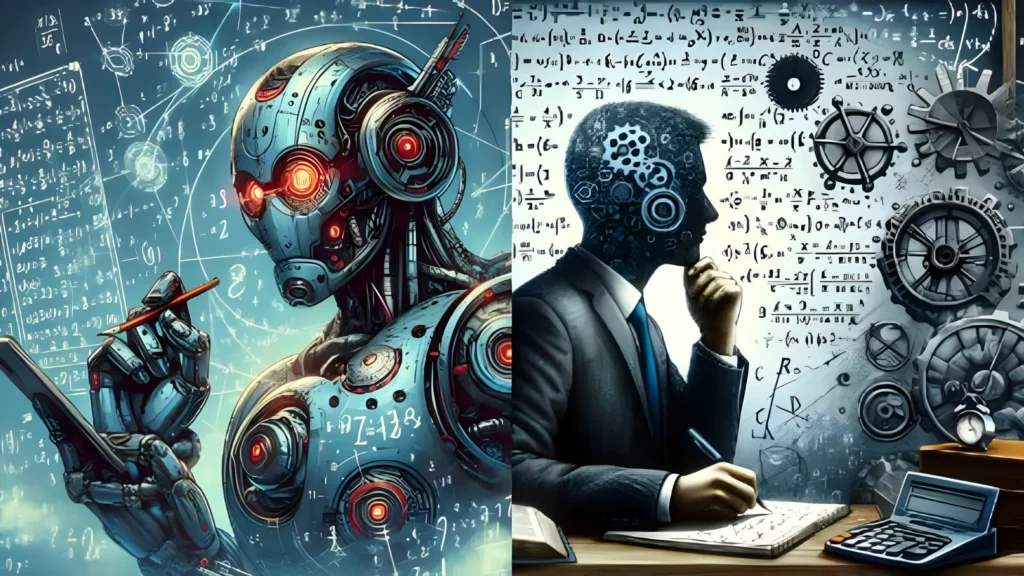
Table of Contents
Introduction AI driven Discoveries in Mathematics- Untangling Knots: AI Reveals Hidden Connections in Topology
- The Counterexample Hunter: AI Plays to Win in Combinatorics
- Automated proof generation and verification
- The Pattern Seeker – Supervised Learning
- The Strategic Explorer – Reinforcement Learning
- The Logician – Automated Theorem Proving
- The Hybrid Mind – Neuro-Symbolic Reasoning
- The Creator – AI-Generated Mathematics (AGM)
Introduction
For millennia, mathematics has been regarded as a creation of the human mind, a discipline defined by abstract thought, creative intuition, and the unwavering certainty of rigorous proof. It was a logical progression from axioms (beliefs) to theorems (useful results), driven by curiosity and intuition. Some of these developments were also driven by scientific curiosity to describe and analyse natural phenomena.
One could say that the upper bound of Mathematical innovation was limited to the Human Intellect of the most genius person on Earth.
Recently, AI has emerged as a ground-breaking technology that is potentially capable of pushing the boundaries of mathematics beyond Human Intellect. It helps us in both finding new dots as well as in connecting them. It is able to generate proofs for mathematical statements, find new relationships/patterns and also come up with creative constructions to hard IMO Geometry problems. It is both guiding as well as driving mathematical research.
“It feels like Galileo picking up a telescope and being able to gaze deep into the universe of data and see things never detected before”
-Marcus Du Sautoy, Simonyi Professor for the Public Understanding of Science and Professor of Mathematics, University of Oxford
Google Deep Mind: Exploring the beauty of pure mathematics in novel ways.
This article is a peek into this fascinating world, where we witness mathematics evolve from a human pursuit into a shared exploration between minds – both natural and artificial. Since the aim is to get a high level overview of the big picture, we’ll just be scratching the surface of many of the topics discussed.
Untangling Knots: AI Reveals Hidden Connections in Topology
In 2021, researchers from DeepMind and the University of Oxford demonstrated that AI is more than just calculation — it can discover. Their work focused on knot theory, the study of how loops can twist and tangle in space, and how such knots can be distinguished using mathematical quantities known as invariants.

For decades, mathematicians suspected a hidden link between two kinds of invariants — one based on a knot’s geometry, the other on its algebraic structure — but no one could pin it down. DeepMind’s team trained an ML model to discover such a pattern and surprisingly, this revealed that a particular algebraic quantity — the signature — was directly related to the geometry of the knot, which was not previously known or suggested by existing theory.
Attribution techniques from machine learning guided Professor Lackenby to discover a new quantity, the natural slope, that hints at an important aspect of structure overlooked until now. Together they were then able to prove the exact nature of the relationship, establishing some of the first connections between these different branches of mathematics.
This wasn’t a proof — it was a conjecture born from pattern recognition at a scale beyond human intuition. Guided by the AI’s insight, mathematicians later proved the relationship, turning the AI’s hunch into a brand-new theorem in knot theory.
The Counterexample Hunter: AI Plays to Win in Combinatorics
Another novel application of AI in mathematical discovery involves reframing abstract problems as competitive games. Researcher Adam Wagner successfully applied this technique, using Reinforcement Learning (RL) to solve several open problems in combinatorics and graph theory.
Disproving a mathematical conjecture often requires finding a single counterexample. Searching for that counter example is like finding a needle in an infinite haystack. Wagner’s insight was to transform this search into a game that an RL agent could learn to master. He framed combinatorial conjectures as graph-building games where the RL agent incrementally constructs graphs and is rewarded for breaking conjectured bounds. Using a simple neural network trained with a cross-entropy–style method, the system generates many candidate graphs, learns from the best counterexamples, and improves over time. By changing only the reward function, the same framework can be applied to many different problems in graph theory and combinatorics.
Despite its simplicity, the approach produced real results. The RL agent found counterexamples to several open conjectures and, in later reimplementations, helped disprove dozens of proposed spectral bounds. Even when it couldn’t solve problems outright, it often guided human mathematicians toward solutions. By gamifying the search, a directionless human exploration is transformed into a directed, reward-driven optimization process that is perfectly suited to the strengths of modern RL algorithms.
Automated proof generation and verification
Imagine a world where every mathematical proof is perfectly, unbreakably true because a computer has verified every single logical step. This is the promise of formal mathematics, often called the “grammar of truth”. The only problem… Translating a brilliant, intuitive human idea into this ultra-precise computer language has always been a painstakingly slow and difficult process. It’s a major bottleneck in mathematical progress.
Enter a new generation of AI-powered assistants like LeanDojo and LeanCopilot. These aren’t your old symbolic solvers that just crunch numbers; they are sophisticated partners in the act of proving.
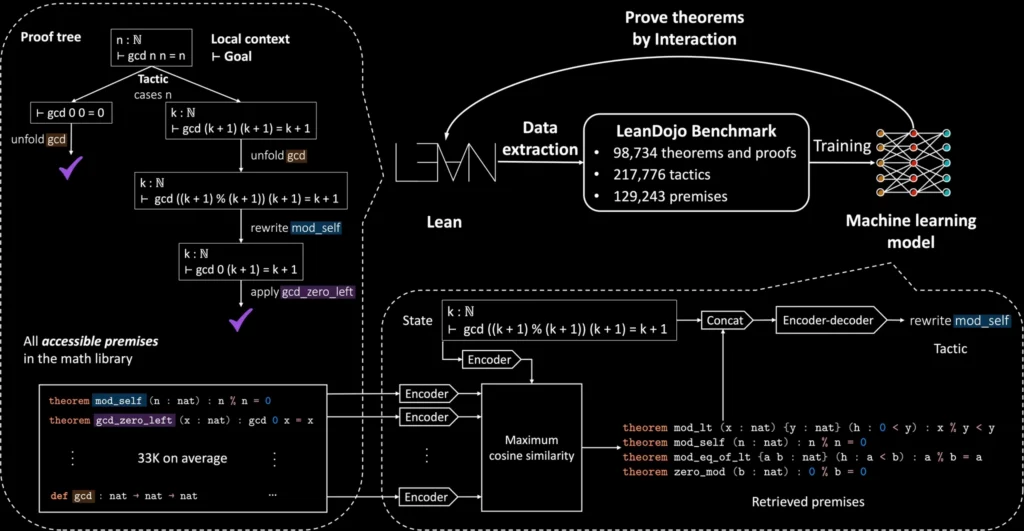
How it Works? Learning to Reason: Built upon powerful theorem-proving platforms like Lean 4, these tools use LLMs that have been trained on thousands of existing formal proofs. By analyzing this vast library of human knowledge, they learn the very patterns of mathematical reasoning.
Their capabilities are transformative:
- Suggesting the Next Step: When a mathematician gets stuck, the AI can suggest missing logical links or intermediate steps (lemmas) to advance the proof.
- Repairing Broken Proofs: If a line of reasoning fails, the AI can analyze the error and attempt to repair the proof automatically.
- Automating the Tedious: They can fill in the logical gaps, handling the meticulous but uncreative parts of a proof, freeing up human intellect for bigger challenges.
In tests conducted by Princeton researchers, LeanDojo was able to successfully complete up to 50% of the unfinished proofs it was given—a monumental leap in automating formal verification.
In this process, humans provide the creative spark, the deep intuition, and the strategy for a proof while AI acts as a tireless, logical assistant, ensuring that every detail is correct and converting human insight into formally verified truth. In this new partnership, machines handle the rigorous verification of our logic, empowering humans to push the boundaries of what logic itself can achieve.
Today’s Mathematician’s Toolkit
1) The Pattern Seeker – Supervised Learning
When you have mountains of mathematical data — graphs, knots, equations, or numerical invariants — supervised learning shines. These models learn to map one mathematical structure to another, uncovering relationships too subtle for the human eye. They’re not proving theorems; they’re whispering hints — guiding mathematicians toward patterns worth investigating. Think of them as conjecture generators for the age of big data.
2) The Strategic Explorer – Reinforcement Learning
Some mathematical problems aren’t about pattern recognition but about strategic exploration — like finding counterexamples or optimizing constructions. Here, reinforcement learning reframes mathematics as a game: the AI “plays” by building objects and learns from rewards when it discovers something interesting or contradictory. It’s the same principle behind AlphaGo, now applied to the infinite chessboard of mathematical search.
3) The Logician – Automated Theorem Proving
When precision matters more than speed, automated theorem provers step in. Systems like Lean, Rocq, and Isabelle check proofs down to the smallest logical atom. Recently, tools such as LeanDojo and LeanCopilot have merged this formal rigor with the fluency of large language models. The AI drafts proofs in Lean’s syntax, while the theorem prover acts as the final referee. If it’s wrong, it’s rejected; if it’s right, it’s verified beyond any doubt. It’s a partnership where “AI imagines, and logic confirms”.
4) The Hybrid Mind – Neuro-Symbolic Reasoning
Some problems need both creativity and discipline — that’s where neuro-symbolic systems come in. By blending neural intuition with symbolic logic, these models think “fast and slow” at once. The neural part dreams up ideas; the symbolic part keeps them honest. Systems like AlphaGeometry use this balance to solve multi-step geometry problems that demand both leaps of insight and flawless logic.
5) The Creator – AI-Generated Mathematics (AGM)
A new frontier is emerging — AI that doesn’t just assist with math but creates it. Using symbolic regression or frameworks like AI-Hilbert, these systems can invent entirely new formulas, operators, or conjectural structures directly from data. It’s like having an AI that rediscovers Newton’s laws — or invents something beyond them. Here, mathematics becomes not just human-made, but co-evolved with machines.
From pattern recognition to proof verification, from exploration to creation — these tools don’t compete; they complement each other. The future of mathematical discovery won’t be led by a single AI model, but by the collaboration of many — each a specialist in a different kind of reasoning.
Conclusion – Beyond the Human Mind
AI is no longer just solving equations — it’s reshaping what it means to do mathematics. It’s extending the boundaries of what the human mind alone can reach. As machines begin to prove theorems we can’t fully grasp, a quiet question lingers:
If an AI proves a theorem but we can’t understand the proof, do we truly know it’s true?
Is mathematics about truth, or about understanding?
Perhaps the next frontier of mathematics isn’t just about finding new truths, but rediscovering what it means to understand them…